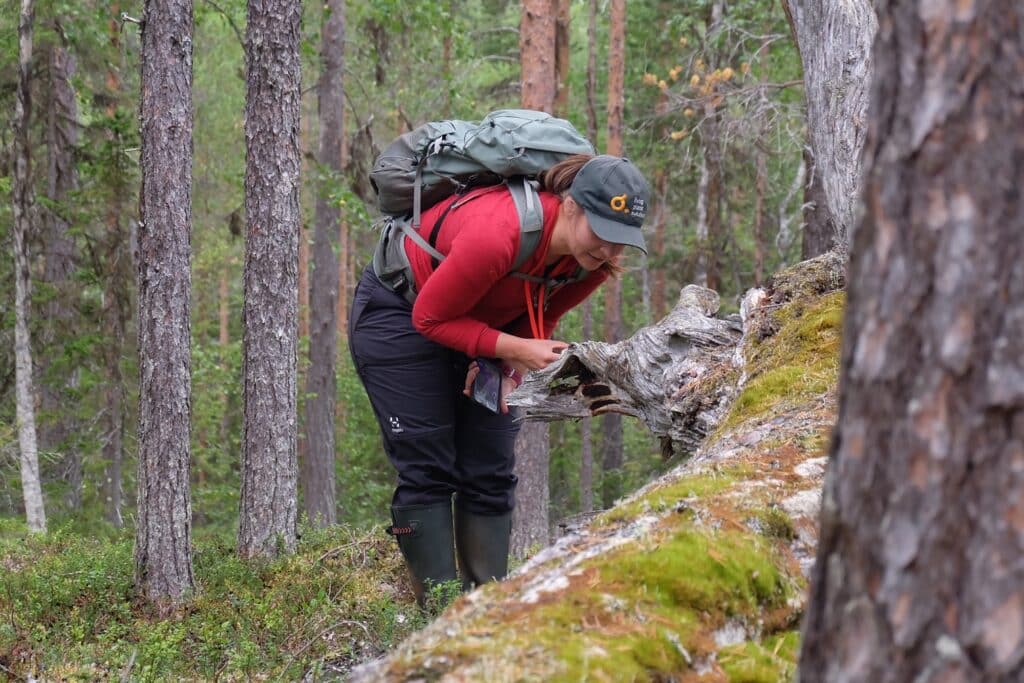
In 36 sample plots spread across Västerbotten and Norrbotten, Ecogain’s experts inventoried dead wood piece by piece, mapped fire scars, and identified wood-dwelling fungi. The inventory now forms the basis for a new scientific article in the prestigious Journal of Ecology.
Wood-decaying fungi are often difficult to identify, and the quality of an entire study depends entirely on whether the inventory is conducted correctly from the outset. This requires both field experience and species knowledge. The article “Distinct diversity trajectories of boreal wood-inhabiting fungi following fire versus clear-cutting” was published in March 2026.
Survey of dead wood and wood-dwelling fungi
Ecogain’s contribution consisted primarily of fieldwork and species identification, in which our experts Torbjörn Josefsson, Ruaridh Hägglund, Tony Svensson, Andreas Bernhold, Andreas Estenssen, and Britta Sterner, as well as former colleague Aron Dynesius, participated. Torbjörn Josefsson also contributed to the scientific discussion of the results and is listed as one of the co-authors of the study.
What the study examined
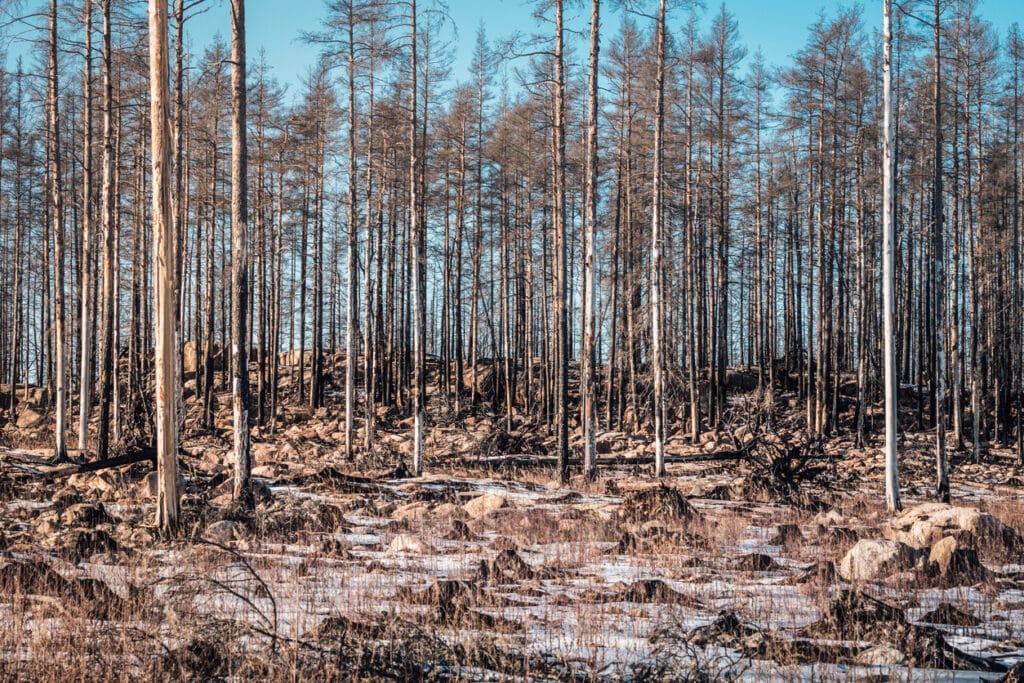
Researchers at SLU investigated how two different disturbances in boreal forests—clear-cutting and stand development following a fire—affect the abundance and quality of dead wood, and, by extension, the diversity and composition of wood-dwelling fungi. The question is ecologically fundamental: dead wood serves as a habitat for a large portion of the forest’s species diversity, and how it forms determines which species can live in it.
The researchers conclude that in forests that have regenerated after a fire, the number of fungal species continues to increase over time as the forest ages, particularly in the case of red-listed species. In contrast, biodiversity in logged forests is significantly lower, and the gap widens over time.
You can read the article here: Distinct diversity trajectories of boreal wood-inhabiting fungi following fire versus clear-cutting