Biological diversity has become a central issue in modern urban development. Municipalities, authorities, and real estate companies are facing increased demands to integrate green infrastructure, manage ecological relationships, and create more resilient urban environments. To meet this growing need for knowledge, Origo Academy developed a vocational college program on biodiversity in urban environments and commissioned Ecogain to lead the course.
The mission – putting biodiversity into practice
During the fall, Ecogain, on behalf of Origo Academy, conducted a ten-week training course for around 20 participants with basic knowledge of urban development and environmental issues.
Ecogain developed training materials, led weekly workshops, and developed discussion topics. The course deepened participants' understanding of biodiversity and ecosystem services in urban environments, with a focus on native plants, species-rich habitats, and green infrastructure.
How Ecogain worked with education
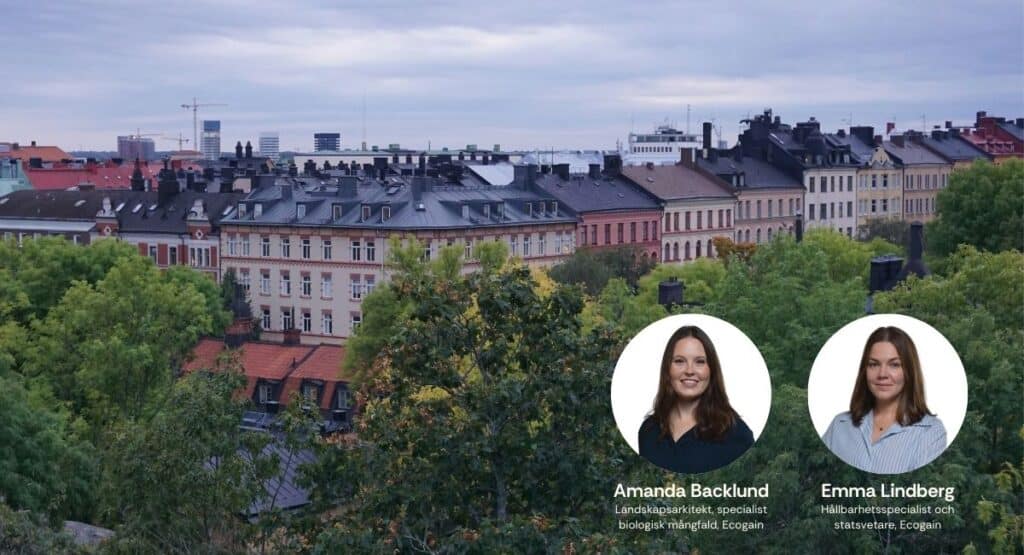
The training was led by Ecogains sustainability specialist Emma Lindberg and landscape architect Amanda Backlund, who combined theory, concrete case studies, and interactive exercises. The approach aimed to encourage participation and link the content to the participants' own professional challenges and experiences.
The educational format—a modern, dialogue-based teaching style—was appreciated by both participants and training management.
What do participants take with them to real projects?
- A deeper understanding of biodiversity in urban environments, which can be used in concrete planning and development decisions.
- Ability to identify and work with ecosystem services in urban planning, from early analysis to measures in the implementation phase.
- Increased awareness of green infrastructure and ecological connections, including how fragmentation can be reduced through conscious choices in project design.
- Experience of a working method that combines dialogue and practical application, with a direct link to the participants' own projects.
Emma and Amanda have kept the course feeling modern and relaxed, almost like an ongoing podcast rather than traditional teaching. The flipped classroom approach worked very well and created space for conversation rather than one-way communication. The combination of theory, concrete examples, and interactive exercises set a good pace that was maintained throughout. The overall impression is that this is a course that feels contemporary, relevant, and very well executed.
– Ronald Larson, Head of Education, Origo Academy.
Relevance for future urban development projects
Through a combination of scientific principles, practical examples, and dialogue-based learning, the training has given participants the tools to integrate biodiversity into their future projects—and thus contribute to more resilient, sustainable cities.
Take the next step in biodiversity work
Would your company or organization like to apply knowledge about biodiversity in practical projects, just like the participants in Origo Academy's higher vocational education course? Ecogain offers training courses for Nature-Smart Business, where you learn how biodiversity can be integrated into operations, strategy, and the value chain.