The European Commission has published its first draft of ESRS standards for sustainability reporting under the CSRD. It wants to give companies more freedom and relax the strict rules compared to the previous proposal by the EFRAG working group.
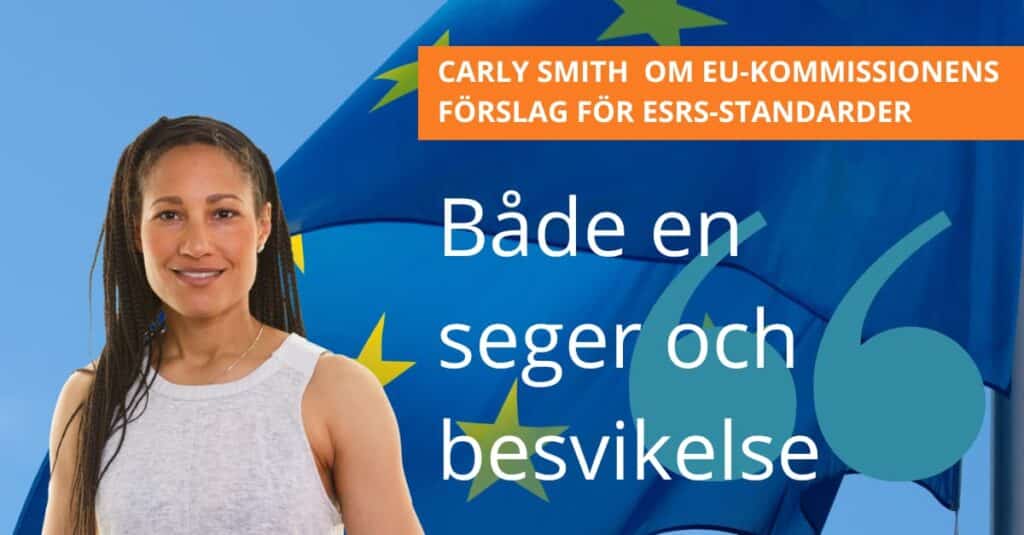
- "For nature and biodiversity, the Commission's proposal is both a victory and a disappointment," says Carly Smith, senior strategist and environmental consultant at Ecogain.
The European Commission says it has made changes to ease the burden on companies and make some reporting requirements voluntary. They have also tried to align the standards with other existing sustainability reporting frameworks, such as GRI.
An important reason for this relaxation is said to be difficulties in securing data for biodiversity and it was feared that the administrative burden would be too heavy initially.
- At Ecogain, working with the new international frameworks, such as SBTN (Science Based Targets for Nature) and TNFD (Task Force on Nature-related Financial Disclosures), we are well aware of the challenges around data. However, we see that the biodiversity landscape is evolving rapidly and many business actors are leading the way in quantifying their biodiversity footprint. Not least through the Climb measurement tool," says Carly Smith.
ESRS provides consistent and transparent reporting
She believes that the European Commission's proposal is still a victory, as it is a major step towards more consistent and transparent reporting of business impacts, both positive and negative, on the ecosystems on which the economy and society depend. The disappointment lies in the fact that the European Commission's proposal is weaker on a number of points than the proposal put forward by the working group (EFRAG), not least that fewer companies will have to report on biodiversity and climate.
For example, transition plans will no longer be mandatory for a number of sectors, and companies with fewer than 750 employees will not have to comply with biodiversity reporting requirements.
- "In conclusion, the EU is taking an important step towards putting biodiversity on the table of business and political decision-makers, even if the step is not quite as big as we had hoped," said Carly Smith. The draft is now available for comments from stakeholders until July 7. "We have already started to receive comments on the draft, with some pointing out the difficulty of comparing sustainability reports across companies," said Ms. Smith.