In recent years, the world has seen droughts, fires, hurricanes and floods escalate in the wake of the climate crisis, and several examples of catastrophic environmental destruction in wars and conflicts. This has put the spotlight on ecocide and the fight to have large-scale environmental degradation recognized as an international crime.
- The consequences of humanity's environmental impact on the planet have now become apparent to all. Making ecocide an international crime is a clear statement of intent," said Nina Macpherson, lawyer and Chair of the Ecocide Law Alliance.
Not too many years ago, ecocide was unknown to most people. The concept of ecocide was established in the 1970s and has been the subject of discussion ever since. It refers to the deliberate and large-scale destruction of the environment. Today, it is a word that is repeatedly mentioned in the EU and the UN, not least in connection with Russia's war of aggression against Ukraine and the environmental destruction this entails.
Today, ecological disasters that transcend national borders rarely lead to any legal repercussions. This is partly due to a lack of appropriate legislation and investigation processes, and because it can take years for the consequences of the destruction to be revealed.
Legal experts have agreed on a definition of ecocide
Nina Macpherson has worked for many years as a lawyer in global companies, and is currently a driving force in the Ecocide Law Alliance, which works to classify ecocide as an international crime and be able to hold guilty actors accountable for damage to the environment and ecosystems.
- "With increased international cooperation, we can hopefully see a change in the way the world deals with environmental degradation," she says.
In 2021, legal experts agreed on a common definition of ecocide as an international environmental crime. However, for it to be used as an international crime in court, ecocide also needs to be added as a new fifth crime to the Rome Statute. The Rome Statute is the basic legal framework of the International Criminal Court (ICC), and it defines the Court's jurisdiction over the international crimes of genocide, crimes against humanity, war crimes and crimes of aggression.
Current environmental crimes drive calls for ecocide
The effects of climate change, the serious threat to biodiversity and the increasing rate of species extinction have raised the profile of ecocide. Several recent events have pushed the issue of ecocide legislation. The catastrophic collapse of the Kakhovka dam in Ukraine could be a turning point that makes the world take ecocide seriously as an international crime.
- The process to make ecocide an international crime is in place, but requires the support of a number of member states. Here, the business community can play a major role in speeding up the process," says Nina Macpherson.
Companies that take a stand show leadership
Among other things, the Ecocide Law Alliance works to rally the business community behind its demands, thus creating greater pressure.
- Companies that actively take a stand on decarbonization or reducing the impact on biodiversity have a major advantage in recruiting the best talent, attracting investment and strengthening their brand. It shows leadership. Supporting the ecocide issue is a simple and clear ethical stand against large-scale environmental degradation.
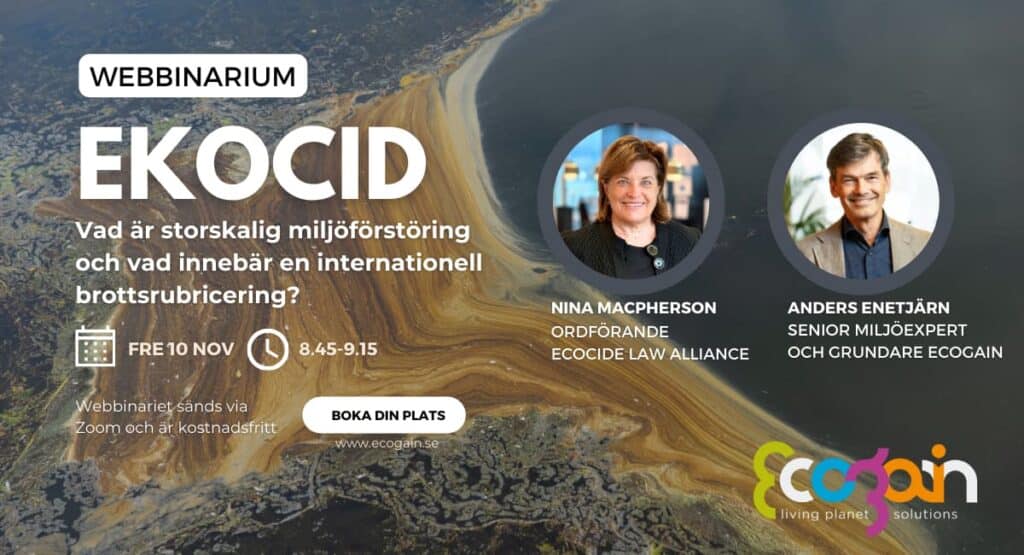
WEBBINARIUM 10/11On November 10 at 8.45 am, Ecogain will broadcast a webinar on ecocide and its impact on the environment and ecosystems, with Nina MacPherson as a guest. Find out more and register here.
EKOCID FACTS
The Deep-Water Horizon oil spill, severe pollution in the Niger Delta and deforestation of the Amazon could be examples of ecocide.
In 2021, a panel of experts drafted legislation that, if adopted, would add 'ecocide' as the fifth crime the ICC can prosecute, alongside genocide, crimes against humanity, war crimes and the crime of aggression.
The Panel defined ecocide as "illegal or reckless acts committed in the knowledge that there is a significant likelihood of serious and either widespread or long-term damage to the environment caused by those acts."